1. Product Positioning
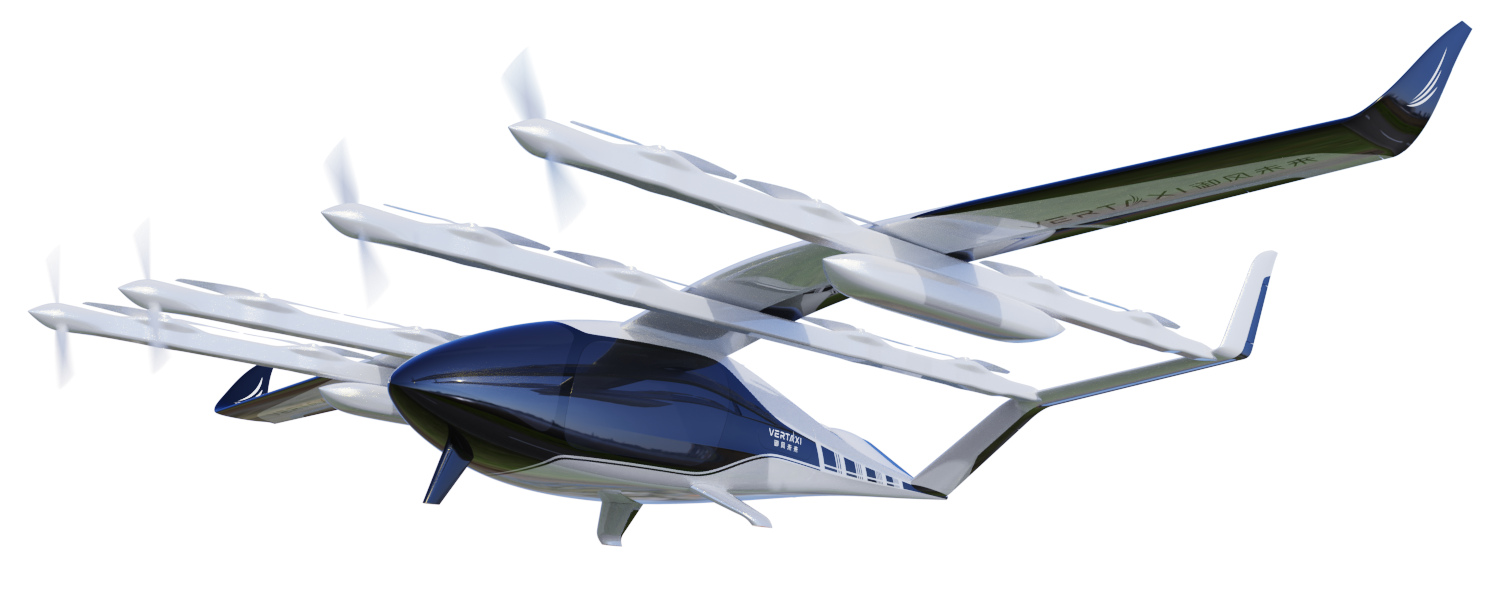
Vertaxi M1 is a 2-ton-class passenger eVTOL positioned as a future "air taxi", designed to shorten 2-3 hour commutes to about 30 minutes for inter-city and intra-city travel.
2. Technical Specifications
Max takeoff weight: 2,500kg
Max payload: 700kg
Seating capacity: 5 passengers
Range: 250km (electric) / 1,000km (hybrid)
Cruise speed: 200km/h
Number of rotors: 20
Configuration: Compound-wing (VTOL + fixed-wing cruise)
3. Key Technology Highlights
100% domestic localization: Electric system, flight control, and composite airframe all independently developed and produced in China.
High safety redundancy: Distributed 20-rotor configuration allows safe landing even if any two rotors fail, meeting the 10⁻⁹/h safety requirement for urban operations.
Intelligent flight control: Predictive-model-based autonomous control algorithm enables pilotless flight, reducing human error and operational risks.
VTOL capability: No runway required; flexible deployment on rooftops and suburban areas.
Green propulsion: Pure electric, zero emissions, low noise.
4. Certification Progress
January 10, 2024: Type certification application for M1B (cargo version) accepted by CAAC East China Regional Administration.
June 2024: First certification review meeting held.
2026: Targeted TC for cargo version, with initial deployment in emergency response, firefighting, and regional logistics.
2028: Targeted passenger airworthiness certification.
2030: Scheduled fixed-route passenger services.
5. Application Scenarios
Emergency response: Aerial search and rescue, emergency cargo dispatch, supply drops – as an "aerial fire truck" and "air ambulance".
Cargo logistics: Regional cargo, cross-city express, island resupply. Vertaxi has secured 100 orders from AVIC Leasing.
Passenger mobility: Urban commuting, inter-city connectivity, island express – building a low-altitude three-dimensional transportation network.
6. Business Philosophy
Vertaxi adheres to the "safety" lifeline of aircraft, insisting on "airworthiness-oriented independent R&D of core systems" and "continuous product iteration for self-sustaining growth". The company pursues realistic, law-abiding practices, exploring business models through real-world applications, and driving iterative improvements with operational data.
 Scan to join the WeChat group

